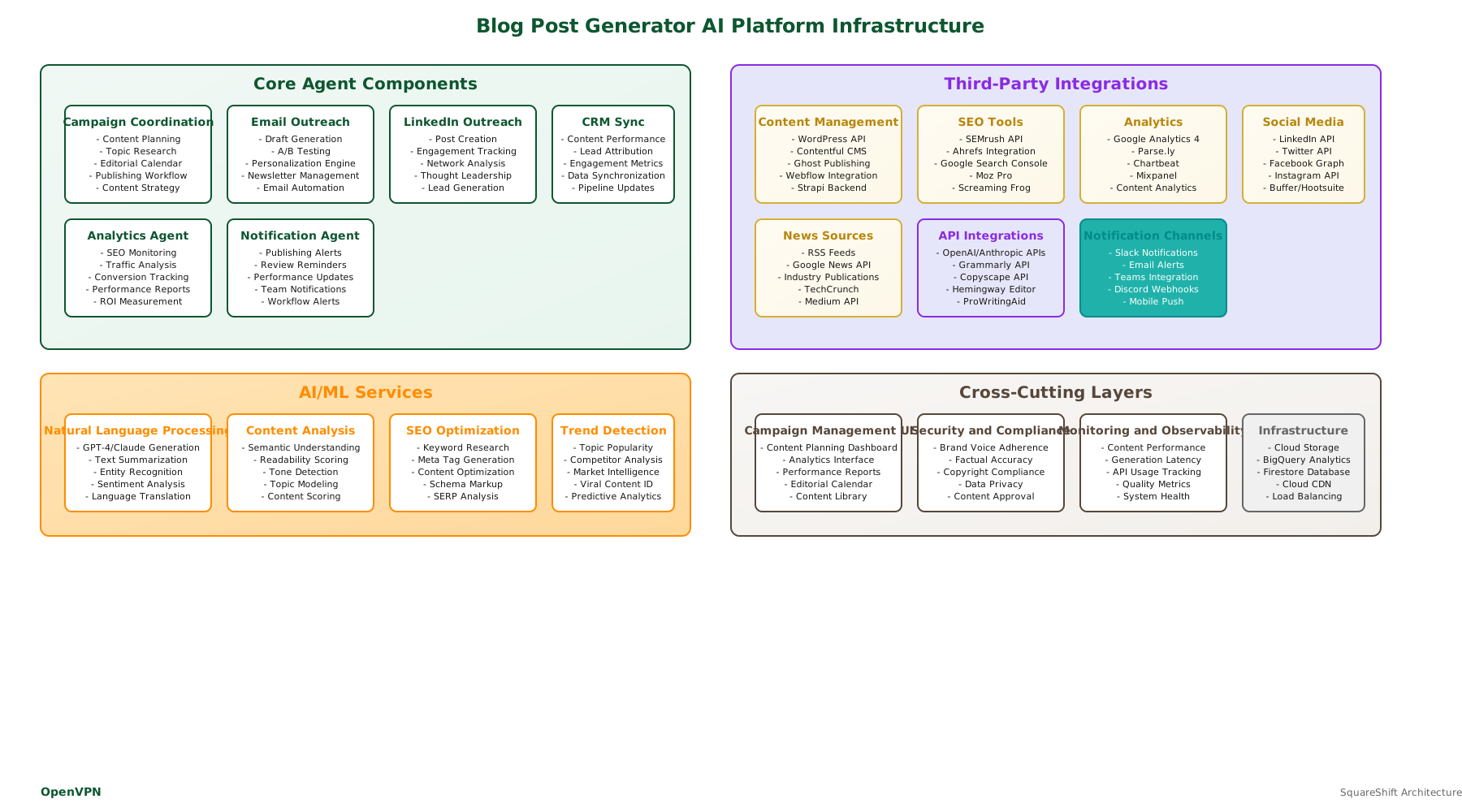

Agent Requirements Document (ARD) for
Blog Post Generator
An autonomous AI agent designed to enhance OpenVPN.net's content strategy by providing data-driven, strategic, and high-quality blog posts.
Goal: To proactively study competitor and industry publications and generate SEO-optimized blog posts that are aligned with OpenVPN's brand voice and address relevant industry news and trends.
Core Intelligence Layer Requirements
The agent's internal "brain," defining its ability to strategize, remember, and reason about its tasks and goals.
Strategy Layer
- Task Planning: Decompose high-level goals into a sequence of executable sub-tasks (research → analyze → outline → draft).
- Goal Mapping: Align content opportunities with business objectives like "increase brand authority in zero-trust."
- Structured Objectives: Define a clear objective for each content piece (e.g., explain, compare, announce).
- Goal Management: Maintain and dynamically re-prioritize a queue of content tasks based on emerging news.
Memory Layer
- Contextual Retention: Maintain conversation context during multi-turn interactions with human editors.
- Knowledge Storage: Store key takeaways from articles in an indexed, vectorized knowledge base for rapid recall.
- Embedding Generation: Create vector representations of internal and external content to facilitate semantic search.
- Information Retrieval: Access historical performance data and past editorial feedback on demand.
Reasoning Layer
- Multi-Step Logic: Execute complex "if-then" logic chains based on competitor actions or market events.
- Chain of Thought (CoT): Produce an auditable log explaining why it chose a specific topic, angle, and structure.
- Query Identification: Formulate precise queries to send to external tools like search engines and news APIs.
- Confidence Scoring: Assign a confidence score to factual claims, flagging those from unverified sources for human review.
Adapter Layer Requirements
Modular interfaces that allow the agent to perceive, act upon, and learn from the external world. These are the agent's "senses" and "limbs."
Perception
- Multimodal Understanding: Process text from articles, social media, and content briefs.
- Natural Language Processing: Use NLP for summarization, entity extraction, and sentiment analysis.
- Sensor Integration: Ingest data from sources via RSS feeds, news APIs, and targeted web scraping.
Tool Execution
- API Management: Interact with SEO tools (SEMrush, Ahrefs) and news APIs.
- Function Calling: Execute specific internal functions like `generateOutline()` or `repurposeForSocial()`.
- Database Operations: Read from and write to its knowledge base and analytics database.
- Workflow Orchestration: Manage the end-to-end content creation workflow.
Learning
- Feedback Processing: Analyze explicit ratings and implicit editorial changes to improve future drafts.
- Reinforcement Learning: Track engagement metrics to reinforce strategies that lead to high-performing content.
- Fine-tuning: Periodically retrain its language model based on the evolving brand voice and successful articles.
Interaction
- Human-in-the-Loop: Provide a web dashboard for content managers to review, edit, and approve drafts.
- Multi-channel Support: Push notifications and summaries to Slack or email when a draft is ready.
- Real-time Communication: Allow for conversational feedback on a draft (e.g., "make the intro shorter").
Deployment
- Cloud Agnostic: Designed to be deployable on major cloud platforms (AWS, GCP, Azure).
- Containerization: Packaged as a Docker container for consistent deployment via Kubernetes.
- Resource Management: Configurable resource allocation (CPU, RAM) to manage costs.
Observability
- Real-time Monitoring: A dashboard showing the agent's status, active tasks, and resource consumption.
- Distributed Tracing: Log all actions and tool interactions with unique trace IDs for easy debugging.
- Alerting Systems: Automatically send alerts on critical errors, API failures, or performance degradation.
Cross-Cutting Concerns Layer Requirements
Global principles that ensure the agent operates securely, ethically, and responsibly, delivering trust and business value at every step.
Security
- Data Encryption: All stored data (API keys, documents) must be encrypted at rest and in transit.
- Attack Prevention: Implement safeguards against prompt injection and other adversarial attacks.
- Authentication: Access to the agent's dashboard must be protected by strong authentication (SSO, MFA).
Ethics
- Bias Mitigation: Regularly audit the agent to avoid generating content that is biased.
- Impact Assessment: Ensure generated content is fair, accurate, and does not plagiarize.
- Responsible AI: Adhere to ethical AI guidelines on data usage and automated decision-making.
Business Value
- ROI Measurement: Track metrics contributing to business value (e.g., lead generation, keyword ranking improvements).
- Business Metrics: Tie agent success directly to marketing KPIs like organic traffic growth and engagement.
- Strategic Alignment: Ensure content suggestions align with quarterly marketing and business objectives.
Compliance
- Audit Systems: Maintain comprehensive logs of all agent activities to support internal audits.
- Regulatory Compliance: Ensure practices comply with relevant regulations like GDPR and DMCA.
- Interoperability: Integrate with standard enterprise systems (CMS, analytics) via stable APIs.
User Trust
- Explainability (XAI): The agent must be able to explain its decisions (e.g., "Why was this topic chosen?").
- Predictability: The agent's behavior should be consistent and predictable to its human operators.
- User Control: Human managers must have the clear ability to intervene, pause, or override any agent action.
Strategy
Content to be determined.
Layered Operating Model of an agent
Content to be determined.
Architectural Patterns
Content to be determined.